
Mikati condemns Israeli aggression in South Lebanon, calls for international intervention

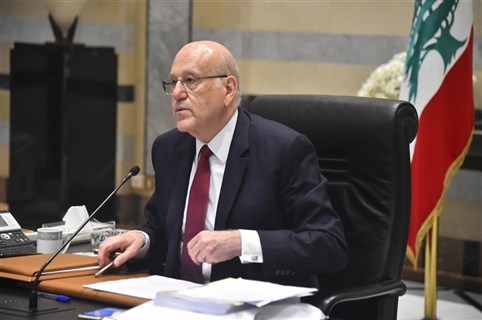
NNA – Caretaker Prime Minister, Najib Mikati, on Friday began the cabinet session with a strong condemnation of ongoing Israeli attacks on South Lebanon. He emphasized that these deliberate killings, destruction of towns, and burning of crops are not only condemnable, but also constitute a destructive and terrorist aggression that the international community must halt. Mikati reiterated Lebanon's commitment to fully implementing UN Resolution 1701.

The PM then expressed gratitude to friendly nations for their efforts to halt Israeli aggression and welcomed UN Security Council Resolution 2732, which outlines a roadmap to cease the fighting in Gaza. He urged for its swift implementation to prevent a broader regional conflict.

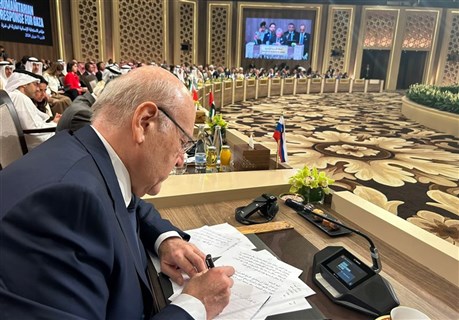
This week, Mikati attended the "Emergency Humanitarian Response in Gaza" conference in Jordan, where Lebanon's presence and stance were reinforced. He emphasized the need for continued support for Lebanon and pressure on Israel. The conference laid the groundwork for another event to launch a support campaign for Gaza and affected areas.

Mikati further highlighted the prolonged vacancy in Lebanon's presidency, urging all parties to engage in dialogue to elect a new president and restore stability to the country's institutions. He welcomed and appreciated all initiatives towards this goal.

The Prime Minister also acknowledged the Internal Security Forces on their anniversary, thanking the UAE for its support and commending Qatar for its continuous efforts to enhance the capabilities of the Lebanese Army.

He celebrated the recognition of the Lebanese University by QS Rankings for 2025 as the top institution in Lebanon for its professional and academic reputation.

Mikati went on to address the proposal from the Ministry of Economy and Trade regarding Qatar Electricity's offer. He detailed the steps taken to negotiate the development of 100 MW of solar power in two locations, highlighting the need for legal and contractual clarity. He noted that TotalEnergies had withdrawn from acquiring existing licenses and emphasized the necessity of a legal framework for a 25-year Power Purchase Agreement.

Looking ahead to the summer tourism season, Mikati praised the efforts of the Minister of Tourism and expressed hope for a successful season that would bolster Lebanon's status on the global tourism map, welcoming both Lebanese expatriates and Arab visitors.

Mikati concluded by reaffirming his respect for the judiciary amid recent political debates, clarifying the government's position on legal matters related to old rent laws and teachers. He extended his best wishes to all the Lebanese for a peaceful and blessed Eid al-Adha.

Mikati at “Urgent Humanitarian Response for Gaza” conference in Jordan: Our south and its people are in a real catastrophe

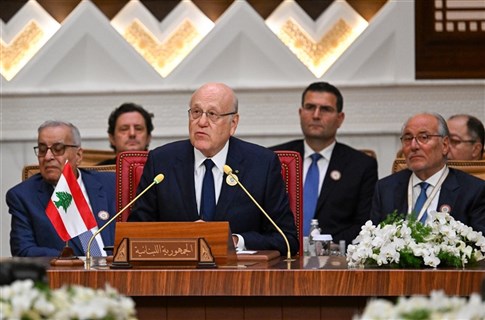
NNA - Caretaker Prime Minister, Najib Mikati, on Tuesday delivered a word at the  ‘Urgent Humanitarian Response for Gaza’ Conference, held at the King Hussein Bin Talal Convention Center in the Dead Sea, Jordan, saying, “We are meeting today to support the people of Gaza in the face of the Israeli aggression. I am coming today from a homeland that is suffering the repercussions of this war on its land, including killing, displacement and destruction."

“The approach of destruction followed by Israel is unprecedented in history, and we experience it daily in Lebanon on the land of our precious south, which has been drenched with the blood of the martyrs and the wounded and has become a land scorched by the lava of crimality, as a repercussion  to the destructive plan in Gaza and a continuation of it,” Premier Mikati said.

“From this platform, we call on the countries of the world to intervene with all force to stop what is happening after 75 years of ignoring the rights of the Palestinians, in the hope that Security Council Resolution No. 2735 that was issued yesterday, which we welcome in the name of the Lebanese state, will be the first step, even if modest, towards stability, in order to reach the desired peace through the Palestinians gaining their right to their independent state. All else are mere projects that will not succeed, and cannot be imposed by the force of reality or the reality of force,” Mikati added.

“Lebanon is accustomed to feeling the Arab pain and carrying the issues of the Arabs because they are its people and family and it has paid a heavy price in terms of the lives of its people and its infrastructure. Today, Lebanon is ready to provide relief to the injured in Gaza, especially children, in its hospitals and to support them as an expression of its solidarity with them, in addition to helping to equip and rehabilitate medical cadres to compensate for Israel’s killing of hundreds of health sector workers.”

“We are also ready to cooperate with the Palestinian Authority to complete the necessary administrative arrangements to facilitate the crossing of the wounded for treatment and then return safely to their country quickly.”

Mikati continued: “You, beloved ones, can imagine the extent of the damage occurring in Lebanon as a result of the ongoing aggression since the eighth of last October. The damage is enormous in educational facilities, health, developmental and agricultural facilities, as well as in livestock and agricultural wealth.”

The PM concluded: “Our south and its people, are in a real and indescribable catastrophe, and the ongoing aggression is continuing to systematically kill, destroy and burn, turning southern Lebanon into a barren and scorched land. Therefore, I am presenting this matter to you so that you can be, as you have always been, standing by your second country, Lebanon, and I am confident that you will not fall short in that... of stretching a helping hand and assisting and repairing the damage, and helping and supporting people in reconstruction and steadfastness... because the symbolic Lebanon will remain an important country for you, no matter how severe the crises are.”

Mikati from parliament: EU aid to Lebanon unconditional

NNA - Caretaker Prime Minister Najib Mikati explained Wednesday to the parliament that the fresh aid package offered to Lebanon by the European Union is unconditioned, and that no agreement has been signed in that respect.

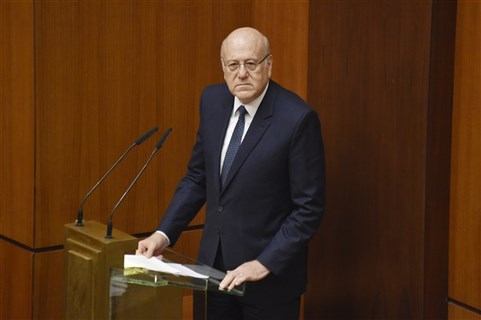
"I confirm that the aid is not conditioned by any prior or subsequent condition, and no agreement has been inked with the European Union regarding it," Mikati told a parliament session devoted to discussing the aid and the displaced Syrians' file.

Mikati stressed the necessity of full accord between the Lebanese to resolve the Syria displacement issue.

"The European aid announced by European Commission President Ursula von der Leyen in the presence of the Cypriot President is a confirmation of the periodic aid the European Commission has been providing to Lebanon for years," Mikati said.

"This European support is devoted to the basic services offered by the Commission to the governmental institutions in the fields of social protection, education, water and healthcare," he explained.

"The President of the European Commission has promised a re-evaluation of this aid every six months in light of Lebanon's need. She also promised doubled amounts and European investments in Lebanon once the required reform laws are approved," he added.

"We insisted that this aid be aimed at encouraging the Syrian displaced to return to their country and not to stay in Lebanon," he said.

"The government has never failed to make the suitable decision regarding the displaced file, and the army and security apparatuses are assuming their duties to curb the unjustified displacement which is threatening the independence of our entity," he underlined.

"What is needed today is a unified national position away from outbidding and accusations," he concluded.

Print


Najib Mikati, un an au Sérail contre vents et marées
Wednesday, Jan 25, 2012

L’Orient le jour - Scarlette haddad


Depuis un an exactement, Najib Mikati a été désigné par une majorité de députés pour former le nouveau gouvernement après la chute de celui présidé par Saad Hariri. Mikati avait ce jour-là créé la surprise en sollicitant lui-même cette investiture alors que le Hezbollah avait pratiquement choisi l’ancien Premier ministre Omar Karamé. Il avait alors l’appui du leader druze Walid Joumblatt qui avait misé sur lui et il a obtenu le soutien du président de la Chambre Nabih Berry et celui du chef de l’État Michel Sleiman. Mikati avait bien étudié son coup, convaincu d’être un « plus » pour une majorité encore peu sûre d’elle et qui craignait le déclenchement d’une campagne internationale contre elle.


Beaucoup de choses, rarement agréables, ont alors été dites contre Mikati, notamment de la part du courant du Futur et de ses alliés, l’accusant, entre autres amabilités, d’être un traître et l’instrument du Hezbollah. Mais au fil des mois (le gouvernement Mikati n’a d’ailleurs été formé qu’en juin), le Premier ministre a montré qu’il donnait du fil à retordre à ses alliés au sein de la majorité, plus qu’à ses rivaux au sein du courant du Futur. D’un calme olympien, peu bavard, il a réussi à s’imposer et surtout à imposer ses décisions et ses choix à une majorité qui croyait pouvoir faire triompher ses points de vue, après s’être notamment dotée de la majorité absolue des portefeuilles ministériels.


En près de sept mois à la tête du gouvernement, Najib Mikati a montré qu’il pouvait résister aux pressions et aux tempêtes sans rien céder sur le fond et en donnant au « centrisme » un rôle concret dans la prise des décisions gouvernementales.


Selon ses proches, Mikati part du principe qu’il est indispensable à la majorité et que l’actuel gouvernement est une nécessité aussi bien pour le Liban que pour la région et même pour la communauté internationale dans une période aussi trouble et confuse pour l’ensemble du Proche et du Moyen-Orient.


C’est ainsi que le Premier ministre a réussi à surmonter la crise qu’aurait pu constituer le financement du TSL, en trouvant une formule (avec l’aide du président de la Chambre) qui a certes déplu au Hezbollah sans toutefois le pousser au désaveu et à faire chuter le gouvernement. Mikati avait bien compris qu’aux yeux de la communauté internationale, le financement du TSL était un test décisif, et finalement, il l’a passé avec succès, et en dépit du cafouillage du courant du 14 Mars qui a commencé par rejeter la formule trouvée, les États-Unis et la France ont mis à l’actif de Mikati la décision du financement. Selon les proches du Premier ministre, c’est avec le même savoir-faire qu’il fera passer le renouvellement du protocole du TSL, en misant sur le fait qu’avec les développements en Syrie et au Nord du Liban, le Hezbollah a désormais d’autres priorités que le TSL.


 Le secrétaire général des Nations unies a déjà pavé la voie au cours de sa visite à Beyrouth en annonçant presque incidemment que la décision du renouvellement relève de sa propre responsabilité et constitue une simple routine. De la sorte, Mikati aura acquis une grande crédibilité auprès de ses interlocuteurs internationaux en se présentant comme un homme qui tient ses engagements et qui peut imposer ses choix. De même, Mikati a réussi à préserver ce qu’il appelle « les droits de la communauté sunnite » en refusant de limoger certains responsables, comme le réclamait la majorité, et en ne donnant pas le feu vert à l’ouverture du dossier des faux témoins.


En fait, à chaque crise au sein du gouvernement, les priorités du Premier ministre sont apparues différentes de celles de la majorité. Pour lui, il tient d’abord compte des « intérêts de la communauté sunnite », et par ce biais, il est toujours soucieux de stopper ce qu’il considère comme « les appétits du chef du CPL », en matière de nominations administratives et de projets de développement. Ses autres priorités sont aussi de préserver ses relations avec l’Arabie saoudite (qui n’avait pas caché son mécontentement lors de sa désignation par la majorité des députés), mais aussi avec le régime syrien et avec la communauté internationale.


Une drôle de feuille de route en somme qui apparaît de prime abord irréalisable, mais jusqu’à présent il a réussi à tenir le cap, en misant sur le fait que, pour l’instant, nul ne souhaite une déstabilisation du Liban. Ce qui rend sa présence à la tête du gouvernement indispensable. C’est d’ailleurs sur ce thème qu’il rejoint la majorité qui considère elle aussi la stabilité du Liban comme une priorité. Autre souci qui fait l’unanimité entre Mikati et la majorité, c’est la nécessité de préserver le secteur bancaire au Liban, considéré comme essentielle pour l’économie libanaise. Mais sur tous (ou presque) les autres sujets, Mikati a des divergences d’opinions tantôt avec le général Michel Aoun et tantôt avec le Hezbollah, quand ce n’est pas avec les deux réunis.


C’est d’ailleurs la raison pour laquelle le gouvernement actuel peine à prendre des décisions au point de se ridiculiser pratiquement auprès des citoyens concernant (entre autres) la majoration des salaires, les nominations administratives, l’électricité, etc. Pour certains, le gouvernement ne pourra devenir plus efficace que si un accord est conclu entre Mikati et Aoun. Mais une telle éventualité ne paraît pas imminente, les deux hommes ayant du mal à faire coïncider leurs agendas respectifs. C’est aussi leurs visions différentes qui empêchent des dossiers-clés d’avancer, comme celui des gisements pétrolifères, celui de l’énergie en général et celui des télécommunications, sans parler de la mentalité « du partage des parts » qui prévaut chez certains protagonistes au sein du gouvernement...


En somme, si le Premier ministre a réussi en un an à s’imposer sur la scène politique, et à déjouer tous les pronostics sur son départ rapide ou sa transformation en marionnette entre les mains du Hezbollah, il n’a toutefois pas réussi à diriger un gouvernement efficace, ni à montrer aux citoyens qu’il est réellement en mesure de régler leurs problèmes. Tout comme il n’a pas réussi à convaincre ses partenaires qu’il n’est pas l’otage de son « sunnisme ».

more videos
حديث الرئيس نجيب ميقاتي إلى قناة الجديد